

The 91´«Ă˝ Valley maternelle welcomes students as young as 2.5 years old. The pre-elementary years are a prime time for learning a new language. Our highly skilled and dedicated faculty creates a safe, supporting and stimulating environment with socialization activities and lessons that grow students’ natural abilities and ignite their desire to explore the world.
Taught by certified native-speaker teachers, our pre-elementary program brings together two educational systems and takes the best each has to offer. From France, we take a rigorous curriculum and from America, we take an empowering approach to education which encourages creativity and critical thinking. Our program is a harmonization between the and the . It centers on cultivating language skills and character development to prepare the students to reach their fullest potential in elementary school and beyond. Maternelle provides the education and pedagogical foundations on which education at elementary school is based, therefore as early as preschool, our students are taught 50 % of the time in French and 50% in English.

What do the students learn?
At the 91´«Ă˝ Valley, students learn self-sufficiency as well as collaboration. We believe language is essential to allow children to express their feelings, share their ideas and opinions, and learn essential concepts. Our priority is for the students to acquire a rich, well-structures oral language which can be clearly understood by others both in French and in English. Students are encouraged to speak up for themselves and express their own thoughts and questions logically as well as follow directions. They learn active listening and the importance of waiting for their turn. They get used to new routines including daily rituals, transitioning between activities, circle time and table activities
Through well-planned lessons, guided as well as free activities, the children develop fine and gross motor coordination in space, as well as sensory, emotional, cognitive and relational skills. Vocabulary, syntax and the rhythm of language are built through daily verbal interactions in the classroom, in the context of physical activities and through stories, dance and song. Our teachers also teach math and science to stimulate the students’ interest for the world around them, students are introduced to numeration, basic geometry, and problem solving. Children learn to draw to express and to represent. Visual, tactile, auditory and vocal activities increase the sensory capabilities of each child. Also through artistic endeavor, children enrich their faculties of attention, concentration as well as capacity for expression. Gently, in incremental steps, the children socialize and develop autonomy. This is the prerequisite for the critical thinking which will come so much to the fore in later years and is at the core of the 91´«Ă˝ Valley’s mission.
An overview of the skills taught in each maternelle grade:
In preschool, starting at 2.5 years old, students learn how to live together. Every day, the focus of circle time is language. 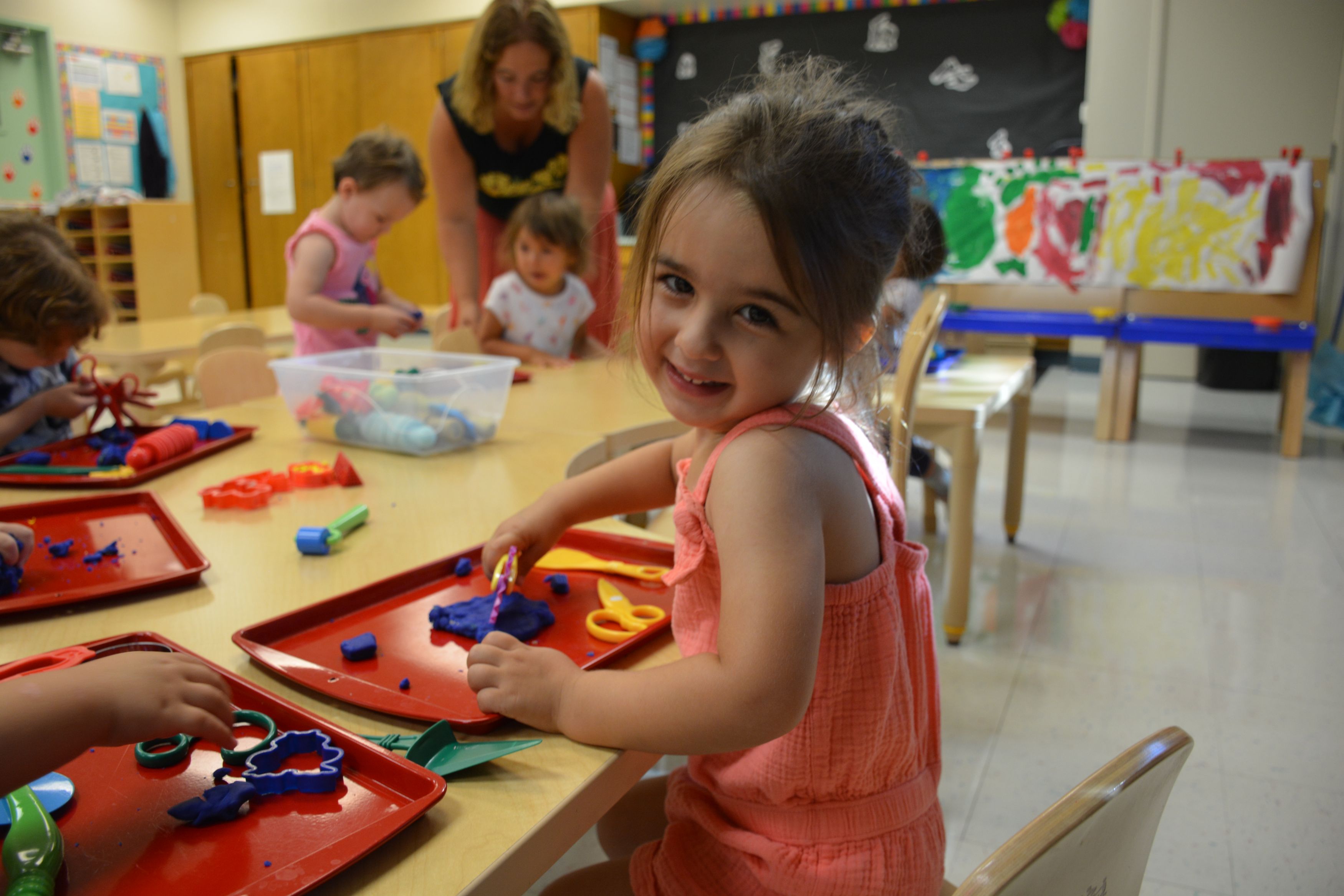 Through the date, the attendance and the weather, the students get familiar with basic words (yesterday, today, tomorrow, the days of the week…). Slowly, they start counting their classmates and numeration is introduced. They are able to match a number with a quantity, they are introduced to notions like more, less, bigger, smaller and to basic geometric shapes. Each period of the year has a theme and lessons are related to the theme. The vocabulary of each theme is introduced in both languages. Students enrich their knowledge of words. The vocabulary learned is reinforced through songs, stories read out loud by the teachers and by different activities. The students learn to answer questions about the books read or put the illustration of a story in order. Students start recognizing some letters, they recognize their own name. They also learn to live together; they are taught how to share, respect others and control their emotions. Students start demonstrating autonomy in their daily tasks and understand and follow one-step oral directions.
In Pre-K, the focus is still on language. Students learn to express themselves in full sentences. They learn new 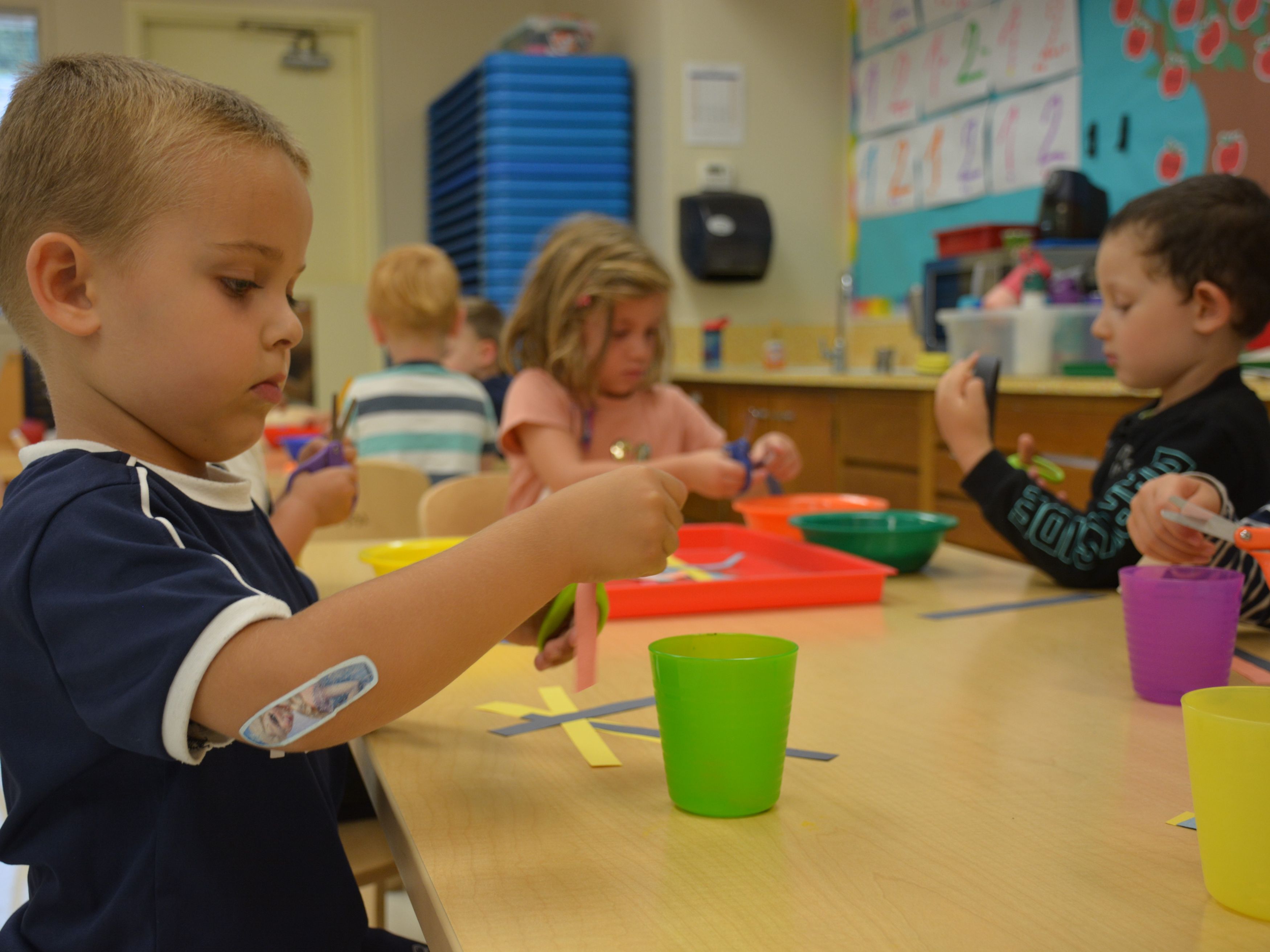 words every day. They are able to retell a story with the help of the pictures, explain, question, recite several rhymes and poems from memory. They know some letter names and sounds, are able to recognize their names as well as their peers’ names in print, and demonstrate curiosity about writing by verbally participating in the production of a written text. In mathematics, they strengthen their knowledge of numbers, are introduced to the number line, and understand that any number is obtained by adding one to the previous number and this corresponds to the addition of one unit to the previous amount. Students learn how to sort objects based on characteristics related to their form, they know how to name simple shape (square, triangle, circle, rectangle …) and recognizes some solids (cube, pyramid, ball, cylinder), they can identify a pattern and continue the sequence. In science, they start placing events in the day, week, month or season. They start making hypothesis while learning about the plant life cycle and building simple models based on drawings. Through social and emotional learning lessons, the students learn to recognize and express their feelings and to channel their emotions.
In Kindergarten, as language is more developed, students understand and follow multiple step directions, they learn to express themselves in full, complex, coherent sentences. They are able to narrate, explain, question, offer solutions, and discuss their point of view. They use appropriate temporal markers (then, during, before, after, etc.) in stories, descriptions, or explanations, they use appropriate spatial markers (front, back, right, left, above, below, etc.) in stories, descriptions, or explanations. They recite several rhymes and poems from memory and with expression, they verbally participate in the production of a written text and understand that one does not write as one would speak. They recognize all the letters of the alphabet and the sound they make, they slowly start reading and writing. They know how to write their name without a model and their classmates’ names, they know how to read and write sight words and even other simple words. They count up to 100, quantify a set to at least ten, compose and decompose by actual and mental manipulation, and know how much to add or remove for amounts not exceeding ten. They recognize and name shapes and solids in both languages, they start graphing numbers and comparing them. They start solving one-step word problems. Students are able to create structures and build simple models based on drawings or assembly instructions. They start using tablets and computers and are able to find a path in a familiar environment from its representation (drawing or coding with Beebots for instance). In science, they recognize the main stages of development and the basic needs of an animal or plant through real life observation or images, they learn to locate and name the different parts of the human body. They perform visual compositions, alone or in small groups, by selecting and combining materials, reusing techniques and processes. They Identify and reproduce physically, or with instruments, simple rhythmic patterns. They cooperate and perform different complementary roles; develops strategies to aim for a common goal.
While our curriculum is highly structures, students at the 91´«Ă˝ Valley form great memories through regular outings, play, music, poetry, art, and their relationships with peers and teachers from other countries. Games and manipulations foster the acquisition of mathematical concepts. Throughout maternelle, the subjects taught remain largely integrated and the social emotional component continues to be developed.
In each grade, the school day features 3 recess times (morning, lunch time, and afternoon) during which the students can let their imagination roam free and keep developing the skills they learned during the daily motricity lessons.
By the end of the three years of pre-elementary/ maternelle school, our students know how to participate in a respectful school environment; they develop productive and cooperative working relationships with others; they know when to listen, when to help and when to ask for help; they learn how to exert control over their emotions and develop the confidence that comes from that; they develop a high level of autonomy in their daily routines; and learn how to participate actively in their own learning; they speak and start reading and writing in both French and English. They have become students and are ready to succeed in elementary school.
Programmes du Cycle 1 (in French)
California Preschool Learning Foundations
California Common Core Math Kindergarten